You are regularly faced with hydraulic sizing or simulation and are not happy with your actual options.
Some colleagues created Excel sheet but basic and quite difficult to use and you are not confident with all the results.
You may also try to run an old-fashioned software, purchased a few years ago but not maintained anymore.
Finally, you will do it with you pen on a sheet of paper, capturing a few figures into one of the two main references “Internal Flow Systems” by D.S. Miller or I.E Idelchik “Handbook of Hydraulic Resistance”.
Fluids & Co is suggesting you a journey with PASS/Hydrosystem to change your life.
FIRST STEP: INTRODUCING YOUR DATA.
Often, the most difficult part is to enter the right data.
Hydrosystem is offering you 2 mains options:
- To enter the network through its great multi-variant Graphical User Interface. The program can switch between different modes and levels of detail (PFD/P&ID – like unscaled scheme with regulated level of detailing, 2D scaled distributed networks on background map, and single line or solid 3D scaled, or unscaled representation for process piping) depending on what is suitable for a specific design phase and pipeline type. PASS/Hydrosystem allows flexible copy/paste features, including the whole fragments. Scenario manager with variables and formulas helps to quickly change input data for different modes of operation of analyzed pipeline.
- PASS/Hydrosystem has numerous interfaces with design and analysis software. This integration system allows you to accurately transfer the geometry of the pipeline and attributive information from the BIM design system to the system for calculating flow rate, pressure and temperature distribution. Using such integration system and other PASS integration capabilities will allow design organizations to effectively organize the design of industrial facilities due to a significant reduction in the time required for re-entering data. In addition, the use of the integration system when CAD tool and PASS are used together excludes the possibility of errors associated with manual data entry into the calculation model.
Transferring model from AVEVA to PASS/Hydrosystem
SECOND STEP: RUNNING YOUR SIMULATION
When all your data have been introduced into the software, you just have to select which kind of simulation you want to obtain:
- to obtain the flow rate of a given network with known pressure differences
- To obtain the ending pressure of a given network with the flow rate and inlet pressure known
- To obtain the inlet pressure of a given network with the flow rate and ending pressure known
- To flow balance a part of your network
- To size a part of your network
Just need to set the requested boundary conditions…that’s all !
Now let’s see the results.
THIRD STEP: OBTAINING YOUR RESULTS IN THE DESIRED FORMAT
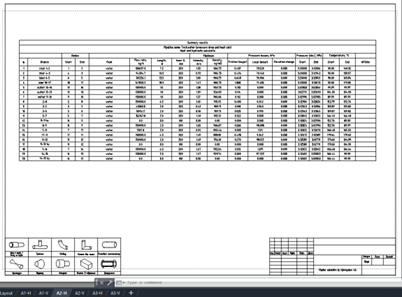
PASS/Hydrosystem includes a List & Label report generator by Combit for printing input and output data.
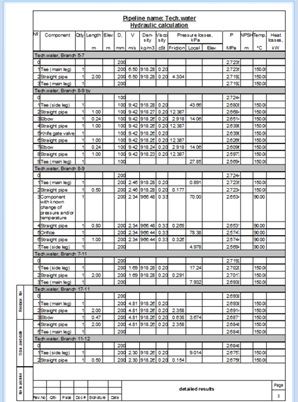
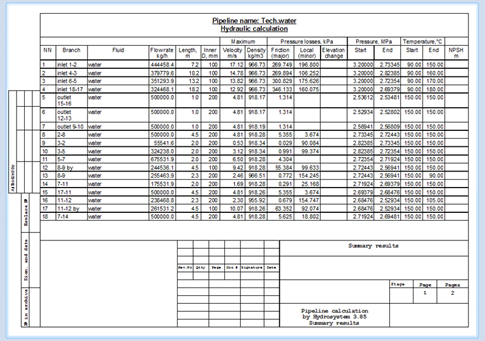
The software allows you to print, preview and save documents (as a List & Label file with an LL extension). The saved files can be viewed and printed using Combit List & Label Viewer, installed with PASS/Hydrosystem.
Reports can also be saved in other formats for inclusion in various documents (for example, pdf files for Adobe Acrobat).
The document template can also be changed. You may, for example, edit the title block format, add the company logo, etc. by using the included form editor, List & Label Designer.
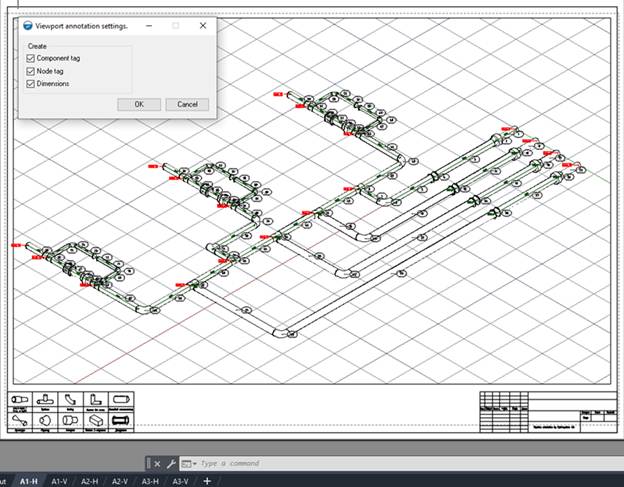
Moreover, PASS/Hydrosystem software can also generate piping hydraulic isometric drawings.
OPTION 1: WATERHAMMER ANALYSIS
You probably have been faced to rapid transient behaviour (also called Water Hammer), by closing a valve or stopping a pump. Not easy to predict it and more difficult to avoid it.
PASS/Hydrosystem will allow you to quickly simulate such events and solve problems.
How to simulate Water Hammer
OPTION 2: MULTIPHASE RESULTS
PASS/Hydrosystem provides a calculation engine for all necessary fluid properties and phase equilibrium on the base of fluid composition, for a wide spectrum of fluids and applications, namely with the proprietary Properties and STARS, GERG 2008 and WaterSteamPro libraries.
For more advanced fluid properties and phase equilibrium calculations the program can use the Simulis Thermodynamics library by ProSim.
Fozen Flow
Two-phase gas-liquid flow can be analyzed ignoring mass transfer between phases (so-called “frozen” flow) or considering vaporization and condensation. Frozen flow analysis can be performed both for isothermal flow and as a heat and hydraulic calculation.
Gas-liquid flow is steady, and phases are in the state of thermodynamic equilibrium and having the same temperature and pressure. “Slippage” of liquid and gas phases can be considered, i.e., their movement at different flow velocity.
During hydraulic analysis of a two-phase gas-liquid flow, the pattern of two-phase flow at different points along the pipeline is found, and for all components the following values are calculated: two-phase flow pattern, void fraction and true phase velocities, as well as hydrostatic losses in components due to elevation change, pressure loss due to friction, pressure loss due to local resistance, pressure loss due to acceleration of flow and Mach number.
Multiphase flow example 1 : frozen flow
PASS/Hydrosystem system utilizes several methodologies for different calculations, from which the user can select the most appropriate methods for any given task. There is also a high degree of flexibility in which methodologies should be used for various types of components in different situations, which can be set using special rules of method selection for two-phase analysis. User defined rules may be used as well as one of the predefined rules included in the software.
Boiling / Condensation
Analysis of two-phase flow considering mass transfer (boiling/condensation) may be performed for pipelines of various structures without recycles. Individual branches are analyzed using direct calculation method, long pipes are subdivided into parts with slight change of calculated parameters, if necessary.
Multiphase flow example 2 : flashing and condensing flow
Change of flow temperature and phase composition for this type of flow is calculated using full energy balance equation. First change of fluid enthalpy is determined, then phase equilibrium based on enthalpy and pressure is calculated and finally fluid temperature and phase composition are obtained.
To analyze flow with mass transfer in unbranched pipeline one may enter pressure in the end node of a branch. In this case the fluid temperature is also interpreted as being entered in the end node. The “upstream” calculation is then performed to obtain initial flow parameters (quality, temperature, pressure).
The analysis determines where in the pipeline the fluid state changes to one phase (liquid or gas). In these points the automatic switch to one-phase methods is performed. Similarly, the reverse transition is recognized (the beginning of boiling up or condensation) with switching to two-phase methods.
For two-phase flow in unbranched pipelines PASS/Hydrosystem determines where the choked flow occurs in the pipeline (at the end of straight pipes, at the exit, in reducers and abrupt expansions).
PASS/Hydrosystem can also do severe slugging prediction. It can calculate settling slurry flow (i.e. liquid + solid particles) including flow pattern prediction.
OPTION 3: LINK WITH STRESS ANALYSIS
You probably need to give your results to some colleagues who want to calculate the fluid effects on the pipe with a stress analysis tools.
PASS/Hydrosystem is of course linked to Intergraph CAESAR II but also the other main software from the PASS suite: PASS/START-PROF.
PASS/START-PROF provides comprehensive pipe stress, flexibility, stability (buckling), and fatigue strength analysis with related sizing calculations according to international and national codes and standards. First introduced in 1965, it combines a highly efficient solver, powerful analysis features, a user-friendly GUI, an intuitive 3D graphical pre/post-processor. It also includes a detailed help system with embedded intelligence from generations of piping design experts.
It can be used to simulate stress behavior from PASS/Hydrosystem results like in the waterhammer example below. Unbalanced waterhammer induced forces on appropriate elements/nodes are calculated and transferred to PASS/START-PROF or other piping stress analysis programs.
Interface between PASS/Hydrosystem and PASS/START-PROF
Moreover, slug flow parameters (size, frequency, speed of slugs, etc.) for gas-liquid flow can be calculated and reported using TUFFP Unified model. Forces in elbows and flow-turns caused by gas-liquid slug flow are calculated and can be exported to PASS/START-PROF software for accounting them in piping stress analysis.
The PASS/ADD SURGE module implements the classical method of characteristics (MOC), using Riemann invariants and explicit numerical methods. It also considers possible cavitation during transitional flow, considering both, column separation effect and distributed vaporous cavitation.
CONCLUSION: HOW TO GO FORWARD AND FURTHER
First introduced in 1977 and blessed with world-known piping hydraulic guru Idelchik, PASS/Hydrosystem has since evolved into one of most powerful piping flow analysis tools.
Founded in 1992, and currently one of leading IT companies, PSRE (Piping System Research & Engineering) Co. now develops PASS/Hydrosystem in interaction with leading world expert associations (AIChE DIERS, TUFFP and others). It is part of a complete solution (PASS software) for engineering of Piping Systems and related equipment including engineering consulting.
The program is under highly active permanent development and improvement, with priorities defined by the needs of existing and potential customers.
Fluids & Co is one of the worldwide distributors. They know very well the various capabilities of the software and are listening to customer requests.
Contact us to know more about PASS/Hydrosystem and your dedicated quote. PASS/Hydrosystem Complete provides comprehensive hydraulic and thermal analysis and related sizing calculations for piping systems of any complexity. Minimum PASS/Hydrosystem local annual license is starting at 1 000 US$. The complete perpetual network license price is 12 000 US$
